
Project detail • AR Game / Custom Controller • 2024
Poltergeist Pursuers
A mobile AR game prototype focused on physical movement and immersion, using a custom-built controller to detect and capture ghosts in the real world.
Project summary
Poltergeist Pursuers was developed as a mobile AR game concept exploring how augmented reality can encourage physical movement and create a stronger sense of immersion than traditional touchscreen-only mobile games. The idea was to combine AR ghost hunting with a custom tactile controller, giving the player a more physical and game-like way of interacting with the experience.
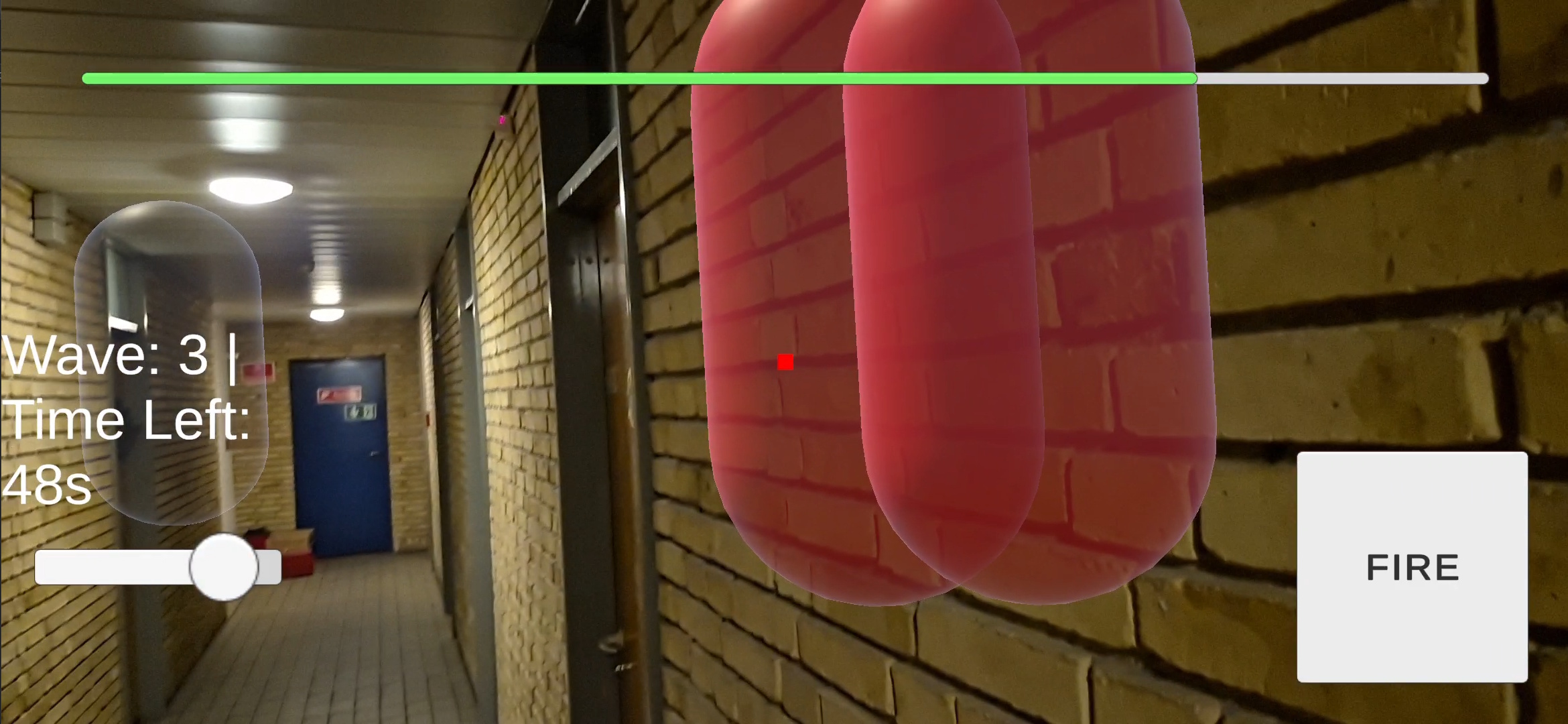
The final prototype uses wave-based gameplay where the player must find and capture ghosts within a time limit. Ghosts become visible only when the correct wavelength is selected using a potentiometer on the controller, while a microswitch acts as the trigger for firing. This made the project both a game design exercise and an experiment in combining AR, hardware input, and physical movement into one system.
Main media
Gallery


Overview
The goal of the project was to investigate how AR and a custom tactile controller could make mobile gameplay more physical and immersive. Rather than keeping the player fixed to simple touchscreen input, the game asks the player to move around their surroundings, search for ghosts, tune into the correct wavelength, and fire at the right moment.
The game is built around wave-based progression. Each wave contains an increasing number of ghosts, and the player has 60 seconds to find and capture them. Ghosts are linked to specific wavelength values represented through colors — green, blue, and red — and they only become visible in AR when the player adjusts the potentiometer close to the correct value. This creates a mix of scanning, aiming, and fast reaction under time pressure.
My role
This was a two-person project. My main responsibility was the Unity side of the project, including the game logic, AR experience, and interface elements that tied the gameplay and controller inputs together on screen.
- Implemented the game systems in Unity
- Built the wave-based gameplay flow and ghost spawning behaviour
- Handled the AR-side interaction and visibility logic for ghosts
- Designed and implemented UI elements such as the crosshair, wavelength bar, timer, and fire interface
- Integrated the app-side behaviour with the custom controller concept
Process and development
The project started as a concept for an AR game that would feel more physical than most mobile AR titles. During early concept development, the team defined a set of core ideas: wave-based progression, ghosts tied to different wavelengths, a visible crosshair for aiming, and a pistol-like controller with a phone holder, potentiometer, and microswitch.
The prototype was developed in Unity using ARCore for Android devices. On the hardware side, the controller was prototyped with an Arduino Uno on a breadboard. The potentiometer acted as a wavelength tuning mechanism, while the microswitch acted as a trigger. On screen, the UI visualized wavelength, aiming, and time pressure so the player could understand what was happening while moving through the AR space.
Testing was structured around three waves of gameplay followed by interviews. Players were first introduced to the controller and mechanics, then asked to complete the game session, and finally interviewed about usability, immersion, and challenge. This gave the project useful feedback on both the gameplay concept and the controller design.
Challenges and solutions
Challenge
One of the biggest challenges was making the tactile controller feel intuitive while still supporting an interesting gameplay mechanic. Test participants generally understood the potentiometer, but several found it difficult to hit precise wavelength values quickly, especially under time pressure. This created a steeper learning curve than a more casual AR game would typically have.
Solution
The project addressed this by keeping the core interaction loop readable: search, tune, reveal, and fire. The visual feedback from ghost visibility made the mechanic understandable even when precise tuning was difficult. Testing also made it clear that future versions would benefit from a progressive tutorial, improved controller ergonomics, and smoother onboarding for players unfamiliar with the system.
Outcome and reflection
The project showed that AR combined with tactile hardware can create a more engaging and movement-based mobile game experience. Test participants found the AR ghost hunting concept immersive, and the combination of visual search with physical input made the gameplay stand out compared to more stationary mobile experiences.
At the same time, the project also highlighted the importance of balancing novelty with accessibility. While the controller added depth and immersion, it also introduced usability challenges that would need refinement in a future version. The report also points to strong future potential in adding multiplayer and wireless connectivity, which could turn the concept into a more social AR experience.
Looking back, this project was a strong prototype for exploring AR gameplay beyond the screen alone. It was especially valuable as an experiment in combining physical movement, custom hardware, and AR game mechanics into one coherent experience.
Want to see more?
You can go back to the projects overview or get in touch if you want to know more about this project.