
Project detail • Web Development / Full-Stack • 2024
Live Satellite Tracker
A full-stack web application that tracks selected satellites in real time using the N2YO API, displaying live positions on an interactive map together with detailed satellite data stored through MongoDB.
Project summary
This project was built as a live satellite tracking application that combines a React frontend, a Node.js backend, and a MongoDB database. The goal was to create a web app that could fetch real-time satellite positions from the N2YO API and present them in a clear and interactive way.
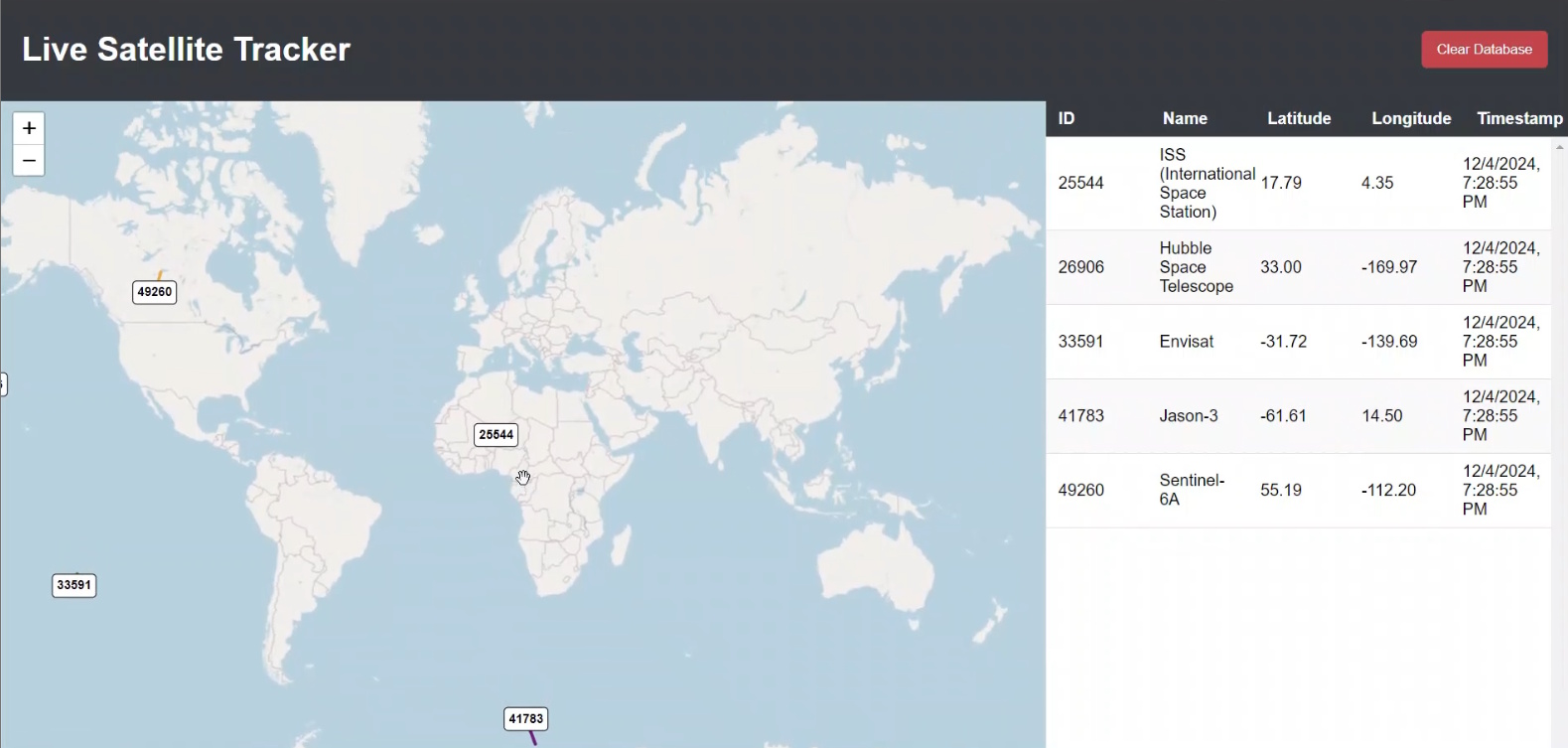
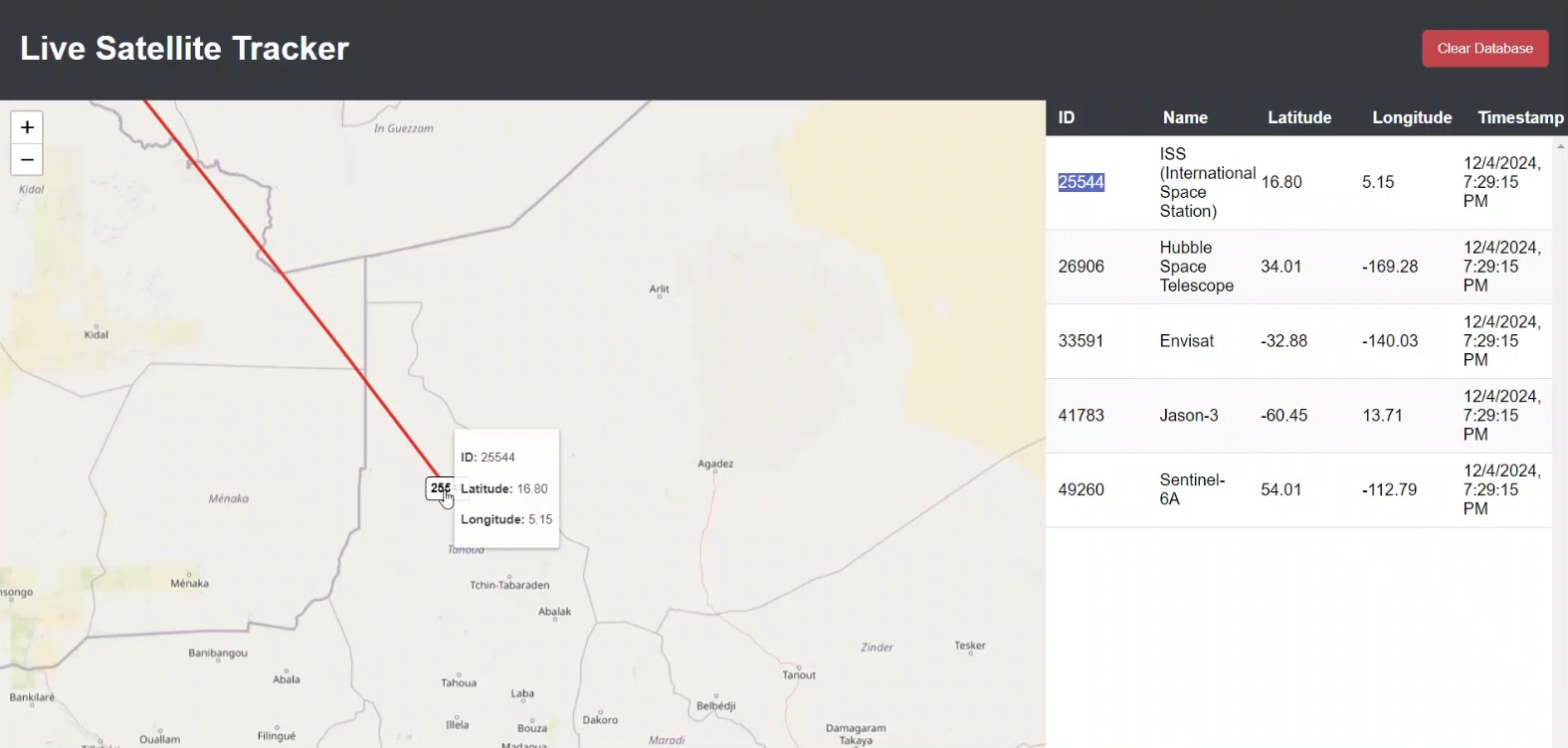
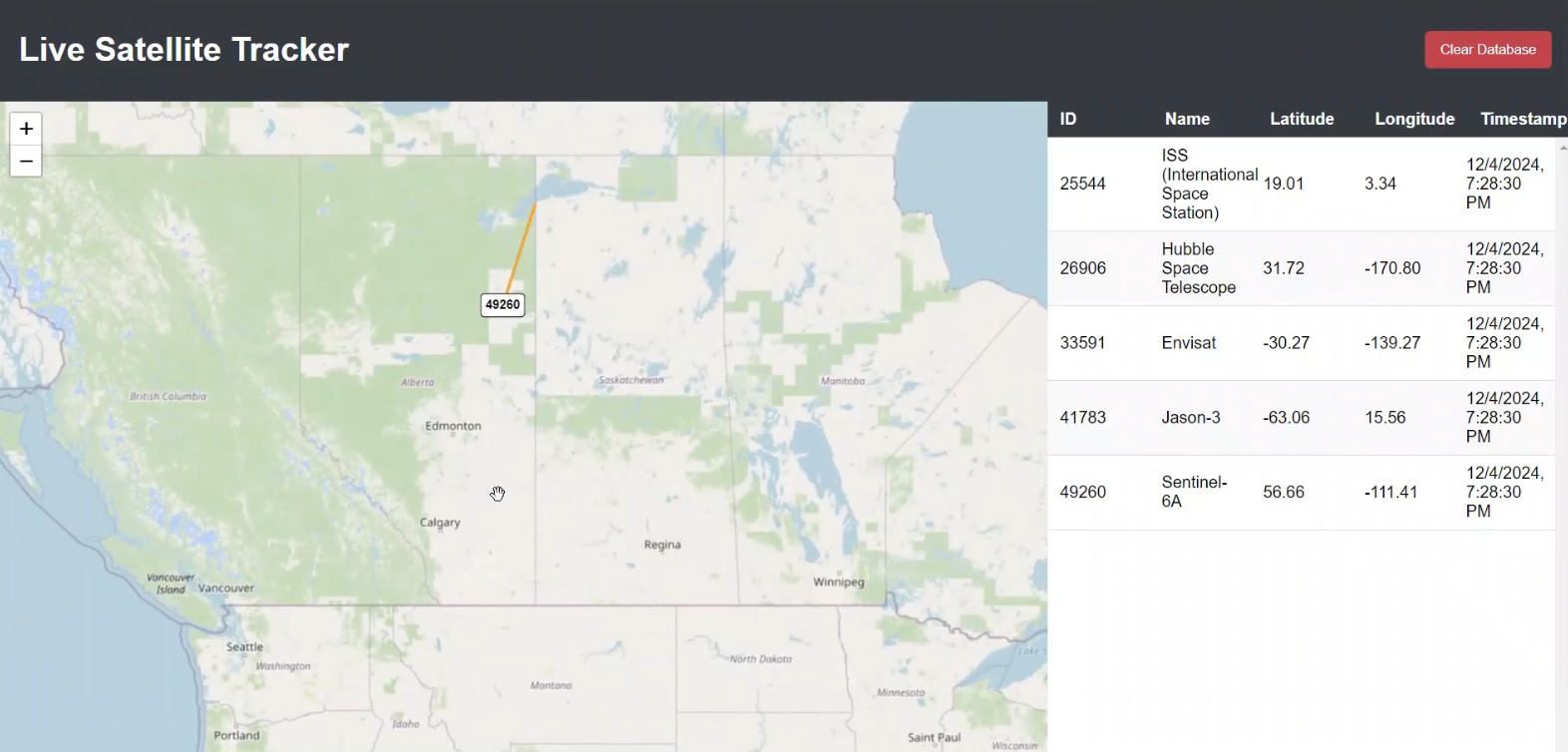
The final result displays selected satellites on an interactive map while also showing detailed information such as satellite ID, name, latitude, longitude, and timestamps in a structured table. In addition to live tracking, the application stores satellite data through MongoDB, making it a practical exercise in full-stack web development and API integration.
Main media
Gallery
Overview
The Live Satellite Tracker is a web-based application designed to monitor the real-time location of selected satellites. The system uses the N2YO API to fetch live satellite data and presents the information in a visual and accessible format through an interactive map and a supporting data table.
The application was structured as a full-stack project with a React client, a Node.js server, and MongoDB for data storage. This made it possible not only to display live satellite positions, but also to organize and manage the data in a more persistent way than a purely frontend-based solution.
My role
This was a solo project, so I was responsible for both the frontend and backend parts of the application, as well as the API integration and database setup.
- Built the frontend in React for map-based visualization and table-based satellite data display
- Developed the backend in Node.js to handle API requests and data flow
- Integrated the N2YO API for live satellite tracking
- Set up MongoDB for storing satellite-related data
- Structured the application so the client and server could be started together through a project start script
Process and development
The project was developed as a combination of frontend visualization and backend data handling. On the frontend side, the focus was on presenting live satellite positions clearly through a map while keeping the supporting table readable and informative. On the backend side, the goal was to fetch data from the N2YO API, process it, and make it available to the client in a usable form.
React was used to manage the user interface, while Node.js handled the server logic and communication with the external API. MongoDB was added to support data storage, which made the project broader than just a live API demo and turned it into a more complete full-stack exercise.
The final interface made it possible to view satellite positions at different map scales, from a global overview down to more local map detail, while still keeping the relevant satellite information visible in the table beside the map.
Challenges and solutions
Challenge
One of the main challenges was combining live external API data with a responsive frontend and a stable backend flow. Real-time position data needs to be requested, processed, and displayed clearly without making the interface confusing or overloaded.
Solution
I addressed this by separating the project into a clear frontend and backend structure. The backend handled the API requests and data management, while the frontend focused on map-based visualization and readable tabular output. This made the application easier to develop, debug, and extend.
Outcome and reflection
The final result was a working satellite tracking web application that successfully combined live API data, frontend visualization, backend logic, and database storage. It demonstrated how a real-time external data source can be integrated into a full-stack application with both technical and visual components.
The project was especially valuable as practice in coordinating multiple technologies at once: React for the interface, Node.js for server-side logic, MongoDB for storage, and an external API for live data. It was a good example of building something that is both technically structured and visually useful.
Looking back, natural next steps would be to expand the application with more filtering, additional satellite categories, historical orbit paths, or richer interaction on the map. Even in its current form, though, it works well as a solid full-stack tracking prototype.
Want to see more?
You can go back to the projects overview or get in touch if you want to know more about this project.