Project detail • AR / Learning Technology • 2024
AR Density Learning App (Course Project)
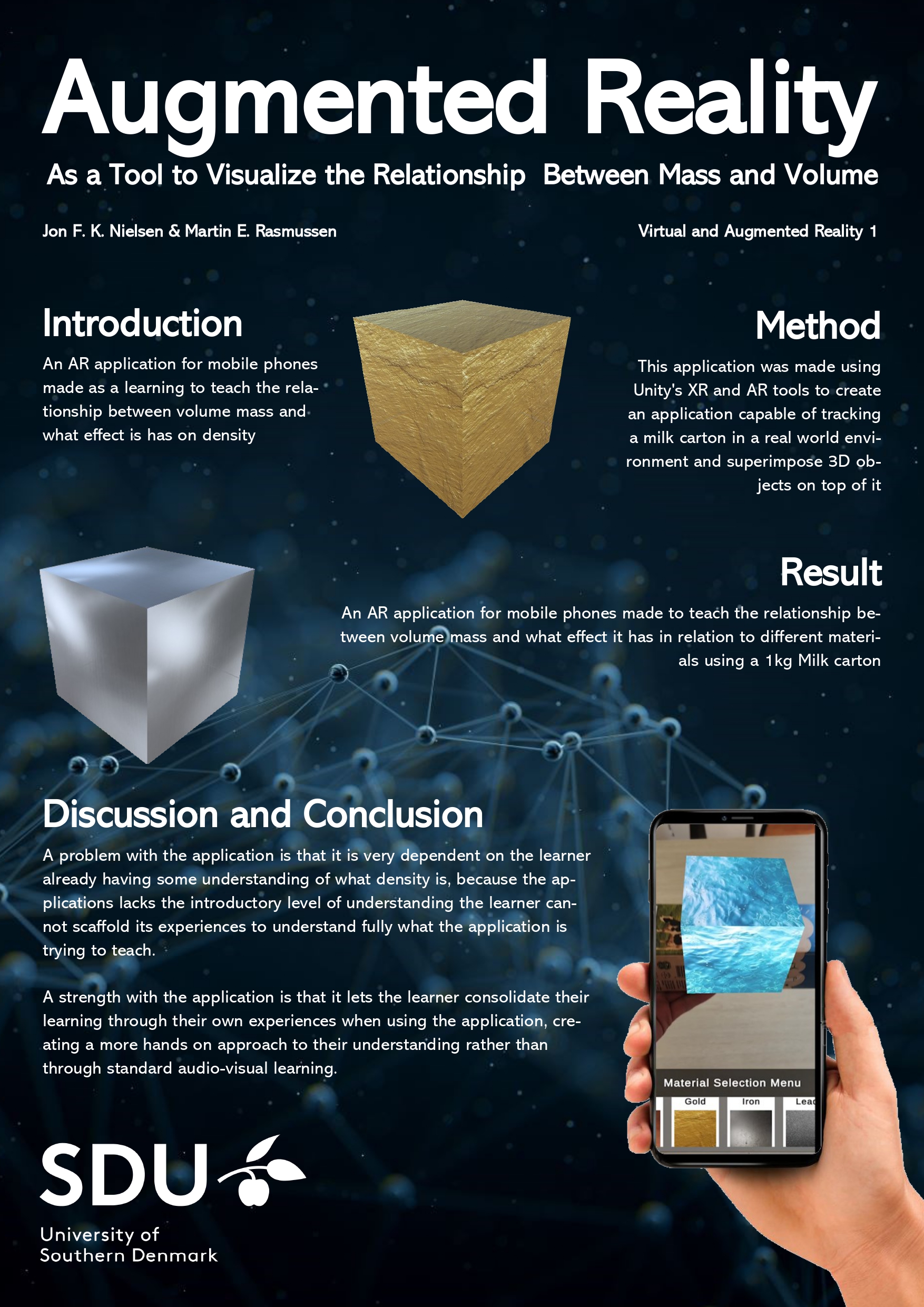
A mobile AR learning tool that visualizes how materials with the same mass can have different volumes by placing a scaled 3D object on top of a tracked real-world milk carton.
Project summary
This project was developed as part of an AR course and explores how augmented reality can be used to support understanding of the relationship between mass and volume. The main idea was to create a simple mobile application that tracks a familiar physical object and places a virtual material on top of it at the correct scale, making density easier to understand through direct visual comparison.
The application was built in Unity for mobile AR and uses a milk carton as the tracked reference object. Different materials can be selected through the interface, and the visualized object changes both size and texture based on the chosen material. The result was a working prototype that clearly demonstrated the concept and later became the foundation for the expanded bachelor project version.
Main media
Gallery
Overview
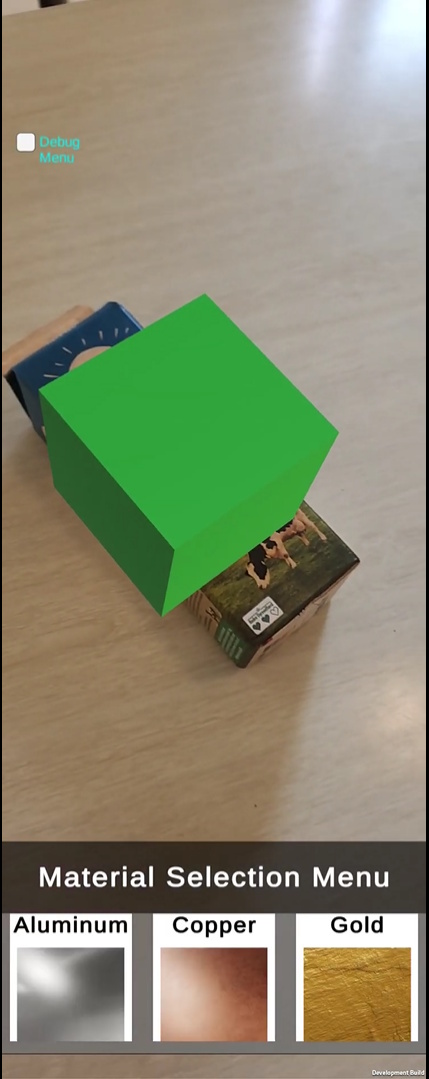
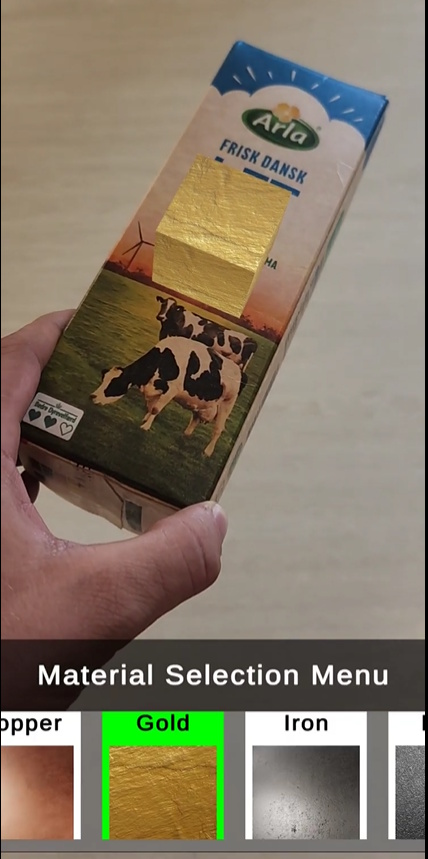
The purpose of the project was to create a learning tool that could visualize how different materials can have the same weight while occupying different amounts of space. The application was designed for mobile phones and uses augmented reality to place a virtual cube on top of a real-world object with known weight.
A one-kilogram milk carton was chosen as the tracked object because it is familiar, easy to obtain, and has a regular box shape that works well for comparison. Six materials were included in the first version: water, iron, copper, lead, gold, and aluminum. These were chosen to show clear differences in density while still being recognizable to the user.
My role
This was a two-person course project. My main responsibility was the implementation of the application itself, including the AR setup, object scaling, interface design, and interaction flow.
- Implemented the application in Unity for mobile AR
- Set up image tracking for the milk carton reference object
- Built the logic for changing material, size, and appearance
- Designed the UI and button-based material selection flow
- Integrated the tracked object, material menu, and scaling behaviour into one working prototype
Process and development
The project began with the idea of using AR to make the concept of density more tangible. Instead of explaining density only through formulas, the goal was to let the user see how different materials with the same weight would vary in size. This made AR a good fit because it allowed a virtual object to be anchored directly to a real object in the user’s environment.
Unity was chosen because it was already familiar to the group and provided the necessary AR and image-tracking tools. The application used Unity’s XR setup and AR Tracked Image Manager to detect the front of a specific milk carton. A placeholder cube was placed on top of the tracked image, and that cube was then resized and retextured depending on the selected material.
The interface was intentionally simple. A scrollable menu at the bottom of the screen let the user switch between materials, and the selected material immediately changed the size and texture of the AR object. This made the prototype easy to demonstrate and easy to understand at a glance.
Challenges and solutions
Challenge
One of the main challenges was tracking stability. The AR object could jitter slightly or slide visually on the milk carton when the viewing angle changed or when the app temporarily lost focus on the tracked image.
Solution
The prototype still worked reliably enough to demonstrate the core idea, and the tracked cube snapped back into place when the app detected the milk carton again. The project also made it clear that a higher-contrast marker or a more trackable reference object could improve robustness in future versions.
Outcome and reflection
The finished prototype successfully demonstrated that AR could be used to visualize the relationship between mass and volume in a simple and understandable way. The application tracked the milk carton, placed a virtual cube on top of it, and updated that cube correctly when the user selected different materials.
From a learning perspective, the project leaned toward a constructivist approach, where the user explores the concept through direct interaction rather than being guided step by step. That made the prototype flexible and hands-on, but it also meant that it assumed some prior understanding of density and offered limited guidance for users who needed more explanation.
Looking back, this project was an important step toward the later bachelor version. It proved the core concept, showed what worked technically, and made the limitations clear enough to guide the more advanced and more structured version that followed.
Want to see more?
You can go back to the projects overview or get in touch if you want to know more about this project.